
Reading Notes on GEB: Gödel, Escher, Bach: an Eternal Golden Braid (Preface)
Why I read GEB
What is the essence of computer science
A mistaken trend often dominates mainstream opinion: the professional knowledge learned on campus is of little relevance to work. This is a typical mass-communication fallacy because it has a market — it satisfies people's familiar mental models of "quick fixes", "social Darwinism", "experience-first", and so on.
In recent years, when I look back at college courses like 《可计算理论》 (Theory of Computation), 《程序设计原理》 (Principles of Programming), and 《离散数学》 (Discrete Mathematics), I find that the knowledge that once seemed dry and useless is actually some of the most beautiful material in computer science. Take a favorite lofty question people like to discuss:
Can artificial intelligence replace humans?
When we study and dig into the theories behind phenomena, many things become clearer and many questions reveal deeper answers instead of remaining at surface-level explanations. This is not to say that formally trained people are necessarily superior to those who come to the field later, but that those who can learn from predecessors without being trapped by them can maintain the clearest logical thinking.
GEB is a staircase toward the essence of computer science
In that sense, the reason I picked up this strange book again is partly to revisit this classic I never finished, and partly because I hope, through the three threads of Gödel, Escher, and Bach, to reorganize my thinking about artificial intelligence, formal systems, and consciousness. Gödel's incompleteness theorems, Escher's drawings, and Bach's musical creations all display self-reference in different ways. They reflect both the powers and the limitations of formal systems and lead to thoughts about intelligence and consciousness. I hope that through my narration these fascinating ideas will shine.
Some popular-science works I like
There are some videos I really like that explain Gödel's incompleteness theorem and Turing's undecidability proof brilliantly; I'll share them here:
Book structure
| Upper/Lower | Chapter | Short review | Link |
|---|---|---|---|
| Upper | Preface | Entry to the book's theme: Gödel, Escher, Bach jointly point to "strange loops", isomorphism, self-reference, and the generation of meaning. | This article |
| Chapter 1: The MU Puzzle | Uses a simple formal system to introduce the difference between "rule manipulation" and "understanding of meaning". | ||
| Chapter 2: Meaning and Form in Mathematics | Discusses how mathematical symbols acquire meaning beyond formal rules; this is the starting point for the book's formal-system questions. | ||
| Chapter 3: Figure and Ground | From perception and frame-switching, shows how meaning depends on the observational framework. | ||
| Chapter 4: Consistency, Completeness, and Geometry | Enters the core limits of formal systems: a system that wants to be reliable and complete encounters deep tensions. | ||
| Chapter 5: Recursive Structures and Processes | Recursion becomes a protagonist, paving the way for later self-reference and strange loops. | ||
| Chapter 6: Where Meaning Is Located | Asks whether meaning resides in symbols, systems, interpreters, or in the relations among them. | ||
| Chapter 7: Propositional Calculus | Using a more formal logical system, shows the power and limits of mechanical derivation. | ||
| Chapter 8: Number Theory as a Formal System | Enables formal systems to express number theory, laying the technical groundwork for Gödel encoding and self-reference. | ||
| Chapter 9: Undecidability and Gödel | Upper-part climax: Gödel's incompleteness theorem formally appears; the formal system begins to speak about itself. | ||
| Lower | Chapter 10: Levels of Description and Computer Systems | Moves from mathematical formal systems to computer systems, discussing how different descriptive levels can coexist. | |
| Chapter 11: Minds and Thoughts | Pushes the issue to the mind: how does the physical brain correspond to thoughts and meaning. | ||
| Chapter 12: Minds and Thoughts | Further discussion of mind, representation, and self-models; a prelude to AI themes. | ||
| Chapter 13: BlooP, FlooP, and GlooP | Uses programming languages and computability to discuss recursion, undecidability, and the boundaries of computation. | ||
| Chapter 14: On Formally Undecidable Propositions | Returns to Gödel's original-paper thread, reinforcing the technical and philosophical significance of "incompleteness." | ||
| Chapter 15: Stepping Out of the System | Discusses whether one can "step outside" a formal system and what that claim really means. | ||
| Chapter 16: Self-Reference and Self-Replication | Extends logical self-reference to system self-replication; an important development of the strange-loop theme. | ||
| Chapter 17: Church, Turing, Tarski, and Others | Brings together computability, definitions of truth, and limits of formal systems, expanding the book's theoretical background. | ||
| Chapter 18: Artificial Intelligence: Prospects and Retrospect | Reviews AI's early paths and discusses why machine intelligence is not merely an engineering issue. | ||
| Chapter 19: Artificial Intelligence: Outlook | Looks ahead to AI and mind issues, connecting creativity, understanding, and self-models. | ||
| Chapter 20: Strange Loops, or Tangled Hierarchies | The book's closure: strange loops become the core metaphor for understanding self, consciousness, and the emergence of meaning. |
Preface — A Musical-Logical Offering
I managed to set Gödel, Escher, Bach — three rare treasures — into a single whole, a great synthesis of diverse gems. At first I intended to write an essay centered on Gödel's theorem. I thought it would be merely a small pamphlet. But my idea ballooned like a sphere and soon touched Bach and Escher. I spent some time thinking about how to make this connection clear rather than merely letting it be the motivation for writing this book. In the end, I realized that for me Gödel and Escher and Bach are just projections of a marvelous unity in different directions. I tried to reveal the gems I found during my odd collecting, and the result was this book.
Gödel
Gödel's incompleteness theorem
Gödel's theorem appears as Proposition VI in his 1931 paper, the paper titled "On Formally Undecidable Propositions of Principia Mathematica and Related Systems I." The proposition is stated as follows:
Formal statement of Gödel's original proposition:
For every ω-consistent recursive class
κof formulas there corresponds a recursive class signγsuch that
ν Gen γorNeg(ν Gen γ)does not belong toFlg(κ).Here,
νis a free variable ofγ.The original is in German, and perhaps you feel this expression still reads Germanic. So here is a more understandable Chinese rewrite:
All consistent axiomatized formal systems of number theory contain undecidable propositions.
That is the pearl.
Gödel used Gödel Number, Self-referential inference and similar proof paths to construct a proposition related to its own provability; this is akin to the so-called "liar paradox" insofar as both exploit self-reference. Similarly, Turing's halting problem proof assumes a halting decider Halt exists and then constructs a program whose behavior contradicts the decider — if Halt says it halts, it loops forever; if Halt says it doesn't halt, it halts immediately. Finally let that program run on itself, generating a contradiction. This is also a self-referential derivation process. Thus we find this structure very effective for proving internal limitations of formal systems.
Attempts to eliminate loops
The book introduces type theory to remove the impact of self-reference (as in the barber paradox, the liar paradox) on set theory. Simply put, it forbids self-reference at the same level. But in real life this is a very strong constraint. If we constrain a formal system to make it complete, we find its expressive power becomes very poor.
The birth of computers and the boundaries of intelligence
No one knows where the boundary between non-intelligent and intelligent behavior lies. In fact, it may be foolish to think there is a sharp boundary. However, the basic capacities of intelligence are definite; they are:
- flexible responses to situations;
- taking full advantage of opportunities;
- making sense of ambiguous or conflicting information;
- recognizing what factors are important and which are secondary in a situation;
- finding similarities among situations that differ;
- extracting differences among things linked by similarities;
- synthesizing new concepts from old ones and recombining them in new ways;
- conceiving entirely new ideas.
Here we meet something that looks paradoxical. Computers are by nature inflexible, desireless, and literal. Although they may be very fast, they remain unconscious entities. So how can one program behavior that requires intelligence? Isn't this the most obvious contradiction? One of the main themes of this book is that there is no contradiction here. One main purpose of the book is to encourage each reader to face directly this apparently paradoxical thing, taste it, fiddle with it, take it apart and examine it, immerse oneself in it, so that the reader may finally re-recognize the seemingly unbridgeable chasms between the formal and informal, the living and the nonliving, the flexible and the inflexible.
So how much do the problems we care about — such as the limits of intelligence and the limits of mechanized proof — actually relate to these self-referential constructions? The author's point is that they are highly related.
Bach
Bach uses the word "canonic" here with a double meaning: it not only means "with canon" but also suggests "in the best possible way." The initials of each word in this inscription spelled together form RICERCAR.
The basic point of canon is a single theme accompanied by its own echo. The various added voices each sing a "copy" of the theme. But there are many ways to do this.
I should also briefly explain what a fugue is. A fugue is like a canon in this respect: it is often built on a theme, played by different voices, in different keys, sometimes with different tempi, inverted, or played backwards. However, the concept of fugue is far less strict than canon, allowing more emotional or artistic expression.
In this canon Bach gives us the first example of the concept of a "strange loop." The so-called strange-loop phenomenon is when, as we move up (or down) through levels in some hierarchical system (here, musical keys), we unexpectedly find ourselves back where we started.
Escher
What I want to say most is: this is very Monument Valley! The visual tricks of illusion are fascinating.
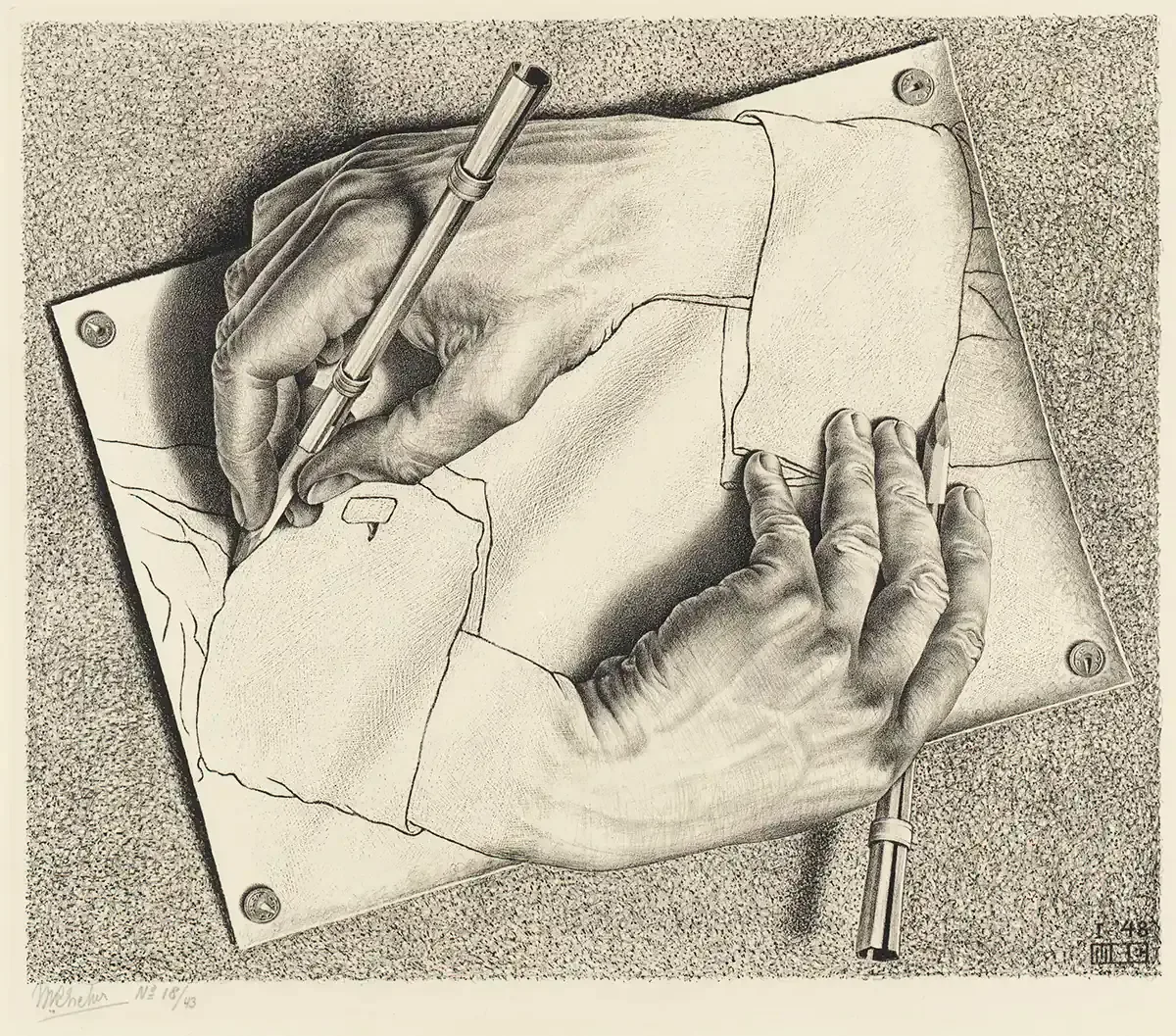 Figure: M. C. Escher, Drawing Hands, lithograph, 1948. Source: Escher in The Palace.
Among them, Drawing Hands is especially thought-provoking: which hand created which hand? Is there a before-and-after relationship between them? The picture seems to deliberately defy ordinary causal logic. They do not conform to causal order; or rather, they form a paradox — yet the clever part is that it can be presented convincingly in the picture.
This is quite related to Gödel's proof: this self-reference and mutual creation/proving process is intuitively similar to Gödel's construction. More importantly, it resembles the "true but unprovable" phenomenon in Gödel's incompleteness theorem: some things cannot be fully contained by the rules internal to a system, yet they do not thereby cease to exist. They exist, but their mode of existence lies beyond what the original rules can explain.
Three creative pieces
Here the book talks about Zeno's paradoxes. I think the best explanation is that infinite series can converge. But this is counterintuitive: how can infinitely many steps be completed in finite time? My understanding is that "an infinite derivation does not imply infinite physical time." Similar arguments apply to the arrow paradox and the like.
But I understand the author uses this paradox as a fable to string together the little stories of the book — in modern terms, to create a "worldview" for a game, film, or novel. I must say I like the author's little cleverness here.